
Underneath every mood, every flash of irritability, every inexplicable flatness, something is always flowing. Not emotion exactly, but something quieter, more in the background.
While the brain feels like it’s for thinking — since that is what it does even when you’d rather it didn’t — its existential purpose is to manage resources like hormones, blood sugar and oxygen, all of which are influenced by hydration, rest and nutrition. An incredibly complex internal accounting that never stops. This process is called allostasis, and there’s a case to be made that what we call mood is its surface. Not a psychological event. A metabolic one — though culture, context and past experience are the very substance of our emotional lives, not footnotes to biology.
If that’s correct, this background quality of feeling that runs beneath discrete emotions functions something like a river flow meter. It doesn’t specify what’s too much or too little, or why the river’s about to burst its banks or run dry — it just registers that things are out of balance. Unpleasant. Flat. Agitated.
The signal also appears to be predictive rather than reactive — upstream of events rather than downstream of them. If the brain adjusts mood in anticipation of what the body will need, drawing on past experience and context, then dread might arrive before the difficult conversation, and certain environments might lift you before anything has actually happened.
If this is correct, there’s a further implication. Because internal shifts are translated into felt mood rather than legible physical sensation, and well below conscious awareness, the cause appears external. The difficult person. The grey light. The ambient sense that something is wrong. Sometimes that’s accurate. But sometimes the river was already running low — and the story came after.
Roommate takes the best bed
Here’s an real-world scenario for how this might play out. I had a spell in a clinic recently (nothing wrong … just tests). But, I had to share a room and the food was … hospital food. By Day 5, I’d had enough of my room mate. Not only did she take the best bed – the one by the window – but she stayed in there all day.
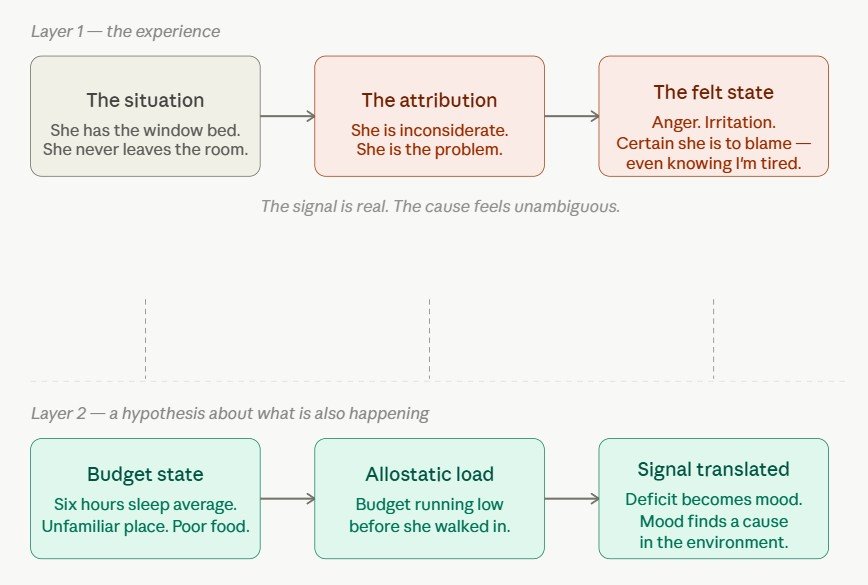
The thing is, even though I know all this, I was still irritated. It made very little dent on how I felt, which I find interesting. It’s also something I see in clients — they know. But it doesn’t solve much.
I’ve written this post because this concept is essential to the work we do at The Analogue Project — but not because you are supposed to feel different just because you know you’re exhausted.
This post draws on the work of neuroscientist Lisa Feldman Barrett, particularly her theory of constructed emotion and the concept of the body budget (A metaphor for how your brain allocates energy resources within your body. The scientific term is allostasis).