
I have long been fascinated by Lisa Feldman Barrett’s work and the Theory of Constructed Emotion, which tells us that emotions are not so much triggered as constructed.
There isn’t anger, sadness or fear sitting inside you, waiting for the right circumstances to activate it. There’s no resistance, laziness, procrastination lying in wait, ready to sabotage your best intentions.
It feels like they are in you — but Barrett’s research shows that emotional experience isn’t a pre-formed state being switched on. It’s constructed on the fly, from bodily signals, your personal history, and the situation you’re in.
Emotion ingredients
The ingredients of this construction can be loosely categorised as interoception (what’s happening in your body), past experience, culture, and context. The brain is essentially running a constant prediction: given everything I’ve experienced before, and the current context, what is most likely happening right now?
What interested me most was the practical implication: if emotions are constructed rather than triggered, then seemingly intractable problems — the ones that have gone stale, the ones where nothing has shifted despite everything you’ve tried — might look very different through this lens.
Memory
Barrett also challenges how we think about memory. Memories aren’t recordings — they aren’t stored like videos waiting to be played back unchanged. They too are constructed each time you recall them, which is why the same memory can feel different on different occasions. Bodily state, context, and culture shape not just how you feel now, but how the past feels when you either reach for it or pops back into your head, uninvited.
Florence’s dilemma
Take Florence. She wants to start sketching again — not for any particular reason, except that she knows she enjoys it, she likes the way her mind works when she draws, and if she’s honest, she feels a stab of jealousy when she’s in the company of someone who does it regularly. There’s no pressure, no deadline, no one waiting and she hasn’t drawn a single line. Something else always feels more urgent.
Maybe she’s just lacking discipline, doesn’t have what it takes?
From a classical emotion standpoint, Florence has a motivation problem — she wants the thing but can’t make herself do it. But Barrett’s framework suggests something different is going on. Florence’s brain is running a prediction every time drawing comes into view, drawing on every previous attempt: the self-consciousness, the gap between what she imagined and what appeared on the page, the low-grade embarrassment of caring about something that felt a bit self-indulgent.
Putting pencil to paper is a risky activity
Her brain has learned that this situation is expensive. Not so much in time (although that’s usually the conscious culprit), but in energy and self-image.
On one side: finish the client work, feel the clean relief of something done. Certain reward, known cost.
On the other: sit down with the pencils, and find out. Florence knows she enjoys drawing. But knowing that cognitively doesn’t help, because her brain isn’t consulting her beliefs — it’s running a prediction.
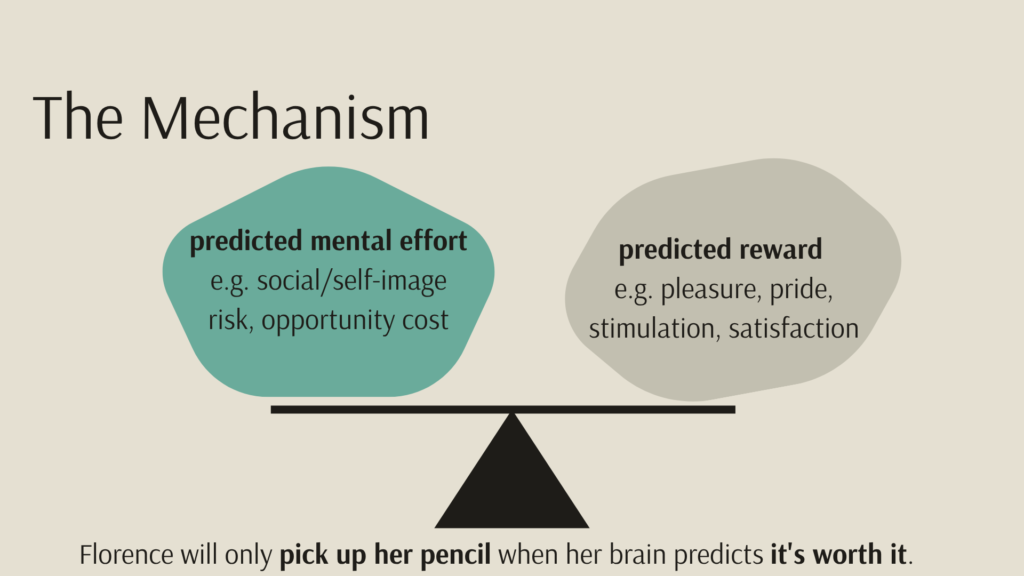
And the prediction includes every time it felt embarrassing, every drawing that didn’t match what she imagined, every suspicion that this is a slightly self-indulgent thing to care about. Uncertain reward. Definite exposure. The client work wins again.
And there’s something else in the prediction too. Florence’s sense of herself is partly built around being someone who draws — or who could. Which means sitting down with the pencils isn’t just a task. It’s a test. The brain prices that in as well.
Florence has a prediction problem, not a motivation problem
This is not a motivation problem. It’s not laziness, or a lack of discipline, or the wrong productivity system. Florence’s brain is doing exactly what brains do — protecting her from uncertain cost. The question is what it would take to change the prediction.
What’s Really Going On
So what would it take to change the prediction? To answer that, we need to go one level deeper — into the machinery the brain is actually using when it constructs an emotion. And that means looking at the body budget.
The brain is an energy budgeter
The body budget is the brain’s running account of your physical resources — energy, oxygen, glucose — and it underlies every prediction your brain makes.
First, the body-budgeting regions issue predictions about your internal state: heart rate, metabolism, energy demands. These produce raw affect — the non-specific sense of feeling pleasant or unpleasant, activated or flat. Barrett is direct:
“Affect primarily comes from prediction.”
Barrett, How Emotions Are Made, p.77
And a meaning-maker
Then the brain needs to make that affect meaningful. It reaches for a concept — “anger,” “fear,” “grief” — drawn from past experience and cultural context. That concept is applied to the body state, the situation, the goal. The result is the thing you call an emotion.
Same arousal, different concept, different emotion. The interoception paper puts it bluntly:
“Just because you feel bad doesn’t automatically mean something bad is happening (or is about to happen) to you.”
Barrett & Quigley, “Interoception: The Secret Ingredient”
Shutting the stable door after the horse has bolted
The practical consequence that almost nobody takes seriously: by the time you’re consciously experiencing an emotion, the prediction is already well underway. Deciding to feel differently doesn’t reach back far enough.
To conclude, I’ll share one of my favorite Barrett quotes:
“Do you believe that what you see influences how you feel? Actually, the opposite is true: How you feel (your ‘affect’) influences what you see, hear, smell, taste, and touch.”